top of page

Privacy Policy

Bat Kol Association (Registered Non-Profit) (hereinafter: the “Association” or “Bat Kol”) respects the privacy of users of its website, operated at the internet address https://bat-kol.org and any additional address as determined by Bat Kol from time to time (hereinafter: the “Website”).

This Privacy Policy explains the privacy practices applicable to the Website. Among other matters, it describes how Bat Kol uses information provided by you and information collected about you during your use of the Website and the Association’s services. In this policy, the term “Personal Information” means any information that can reasonably be used to identify you, including your full name, address, telephone number, email address, and similar details.

This Privacy Policy constitutes an integral part of the Website’s Terms of Use. The policy is written in the masculine form for convenience only and applies equally to all genders and identities.

Reporting a Violation of Privacy

If you believe that your privacy has been violated while using the Website or any of Bat Kol’s services, please contact us at: info@batkol.org.il.
Representatives of the Association are available to address any request, question, or complaint.

Providing Personal Information to the Association

Use of the Website itself does not require registration or the provision of Personal Information. However, certain sections and features of the Website—such as contact forms, registration for events and activities, joining study groups, registration for conferences and workshops, subscription to mailing lists, online donations, and volunteering—may require the provision of Personal Information.

Mandatory fields will be clearly marked. Failure to provide the required information may prevent completion of the registration or requested action. You undertake to provide only accurate and complete information.

Bat Kol may retain additional information regarding your inquiries and correspondence with the Association, including requests and personal assistance provided.

If you provide Personal Information relating to a third party, you hereby declare that you have obtained that person’s explicit consent to provide such information for use in accordance with this Privacy Policy.

Information Collected During Use of the Website

During your use of the Website, Bat Kol may collect information regarding your usage patterns, including:

  • Pages viewed, actions taken, and services of interest

  • IP address, browser type, operating system, and device type

  • Aggregated, anonymous statistical information באמצעות tools such as Google Analytics or other analytics services

Social Media

The Website may include options to share content on social media platforms such as Facebook, Instagram, Twitter, or LinkedIn. Please note that use of these services is subject to the privacy policies of those platforms and not to this Privacy Policy.

Use of Information

Bat Kol may use the information collected or provided by you for the following purposes:

  • Providing services and registering users for events, conferences, workshops, and social activities

  • Sending updates, newsletters, information about the Association’s activities, and relevant content related to LGBTQ+ pride, Jewish law, women’s leadership, Jewish feminist scholarship, education, and related fields (subject to consent)

  • Improving the user experience on the Website and in the Association’s activities

  • Maintaining contact with the community of members, volunteers, and participants

  • Complying with legal obligations and lawful requests from competent authorities

  • Enforcing the Website’s Terms of Use

Disclosure of Information to Third Parties

Bat Kol will not transfer Personal Information to third parties except in the following circumstances:

  • For the purpose of providing services (such as payment processors, mailing systems, or virtual meeting platforms)

  • Pursuant to a judicial order or legal requirement

  • In the event of a legal claim between you and the Association

  • Where disclosure is necessary to prevent serious harm to a person or property

  • As part of a structural change in the Association (such as a merger or transfer of activities), subject to the new entity’s commitment to this Privacy Policy

  • Transfer of anonymous or aggregated information that does not personally identify you

Cookies

The Website uses cookies to ensure proper operation, collect statistical data, personalize services and user preferences, and for information security purposes.

You may modify your browser settings to refuse cookies or to notify you when cookies are sent. However, blocking cookies may impair proper use of certain Website features and services.

Information Security

Bat Kol employs systems and procedures designed to protect information security. However, the Association cannot guarantee absolute protection against unauthorized access or disclosure. By using the Website, you acknowledge and accept this limitation.

Right to Access and Correction

Pursuant to Israel’s Protection of Privacy Law, 1981, every individual is entitled to review information held about them in databases and to request correction, updating, or deletion of such information. Such requests should be directed to the Association via email at: info@batkol.org.il.

Storage of Information Outside Israel

Information collected through the Website may be stored on servers located outside the State of Israel. By using the Website, you consent to such storage.

Changes to This Policy

Bat Kol reserves the right to update this Privacy Policy from time to time. In the event of material changes, a notice will be published on the Website. Continued use of the Website constitutes acceptance of the updated Privacy Policy.

Favicon.png

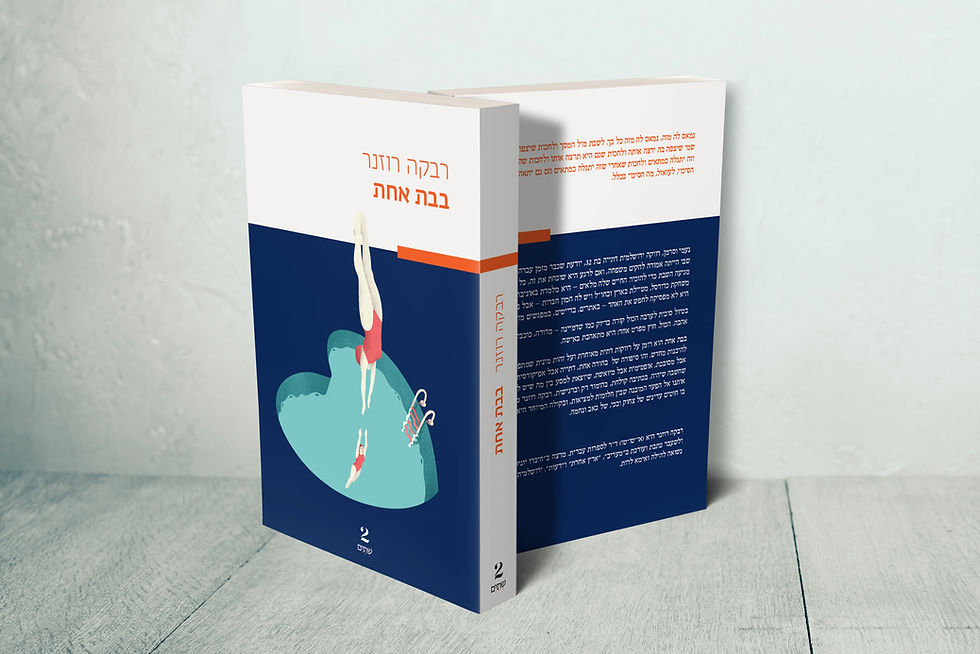
"Bevat Achat" Rivka Rosner's Book

ree


Finding the Story

At the beginning of my relationship with Shiloni, I would constantly tell her:

"This isn’t my story. I can’t tell myself this story. We’ll have to part ways."

She would elegantly ignore the last part of the sentence and instead guide me through a kind of guided imagination:

"Close your eyes. Here we are ten years from now, in a house with a garden (ha, in our dreams), sitting with our two daughters (someday, someday, no, there’s nothing to tell yet), on the wooden swing sofa, talking about how the day went. Maybe friends drop by for coffee—or beer, why choose if we can have both? And you’re no longer eating at me and stressing me out." (Ha, in her dreams.)

At the end of each guided scenario, she would ask:

"Does this help?"

And I would answer:

"Yes."

For at least ten minutes, I was inside a story I could live with peacefully.

Learning Empathy Through Writing

About a decade ago, a friend told me her life had gotten complicated. She was in love. A charming, attentive man, with conversation, touch, and laughter she had never known. Amazing sex. Sounds great, right? Except for the small detail: she was married. Not to him.

"I felt I couldn’t look at her. I knew him, her sweet partner. I thought she was doing him a terrible wrong."

I realized the only way I could continue loving her was to truly understand her. In other words: to be her. I sat down and began to write—her, her voice, diving into her mind, heart, and body to feel what it was like from there.

After 7,852 drafts, it ended up as a novel called “You Know We’ve Arrived,” which Eshkol Nevo and Orit Gidali read and told the workshop participants:

"For a text like this, we set off fireworks."

In the end, the novel was shelved. But that didn’t matter. The imagined story restored my friendship. I understood her. I forgave her. I returned to loving her wholeheartedly.

Writing as a Way of Understanding

When I got entangled with Shiloni, I realized that, with all due respect to my psychologist—and there is respect!—my way to solve it for myself was:

  • Pen and notebook, in the romantic version.

  • Keyboard and back pain, in the real version.

Five years ago, I sat down to try to explain to myself why and how Shiloni happened to me. The answer was: I am the luckiest person alive, but I didn’t know how to say that then. I knew the only way to unravel it for myself was through a story.

So I wrote—a stream of swirling thoughts pretending to be a story. But it wasn’t a story; it was just eating at my brain on paper. It didn’t calm me.

I rewrote it: something with a clearer beginning, middle, and end, and a little less “but what do I do, but what do I do, but what do I do” in the middle.

One editor told me about a slightly more polished draft:

"I don’t know your family or your life story, but I tend to believe you haven’t removed your testimony dramatically… I urge you to release it and be true to the text, not life. In the end, we’re reading a story, not a person."

I listened. Version by version, draft by draft, I distanced myself from both myself and Shiloni to reach Naomi, Sela, and their story. The frame stayed the same—a woman who overthinks meets a stunning curly-haired photographer who opens her heart and collapses her identity—but most details became fiction.

The fiction allowed distance, and distance allowed me to finally see clearly what had been too close to bear.

Naming the Unspoken Pain

Gradually, I found words for:

  • The loneliness of being single, which I hadn’t dared acknowledge before.

  • The grief of an aging body without being loved, a grief I knew but ignored.

  • Family relationships, close, loving, painful, intertwined.

  • Friendships, the ones that sometimes keep us sane.

  • Self-deprecating humor, the key to surviving life.

  • The search for love, in all its forms—the thing we all do here constantly.

Literature as Witness

Slowly, the story became one that explained far more than Shiloni and I ever could. French philosopher Jean-François Lyotard says that literature’s role is to give voice to the unspoken:

"The role of the philosopher, historian, and artist is to witness the suffering or loss that has no expression within the rules of common discourse."

There are a million books about searching for love, I know. But there was no prose book I had encountered that voiced:

  • The solitude of a single religious woman over thirty

  • The silent yearning for touch

  • The weekly search for a Shabbat meal

  • Conversations about children’s welfare to which one has nothing to contribute

  • Fluid sexual identities

  • Women’s fragile self-image at every age

  • The joy of discovery mingled with fear

  • Self-deprecating humor—the very things that make life possible

No book giving voice to the suffering of religious women in silence.

A Message for the Reader

I hope you find in the book a voice of your own that has yet to be heard. And if not, I hope it helps you understand someone near you, close by, who hurts even while hiding it.

I hope you find, after the pain and grief, love, comfort, and laughter.

Because that’s life—everything mixed together, sometimes all at once.

Revekki Rosner, author of “All at Once”, PhD in Hebrew Literature, lecturer at Bar-Ilan University and Hebrew Union College, researcher at the Hartman Institute. Mother to Ruth and Hillel.


Comments


bottom of page